
Social Media Marketing Tips & Strategy
11 min read
How to Grow a Local Business on Instagram Without Paid Ads

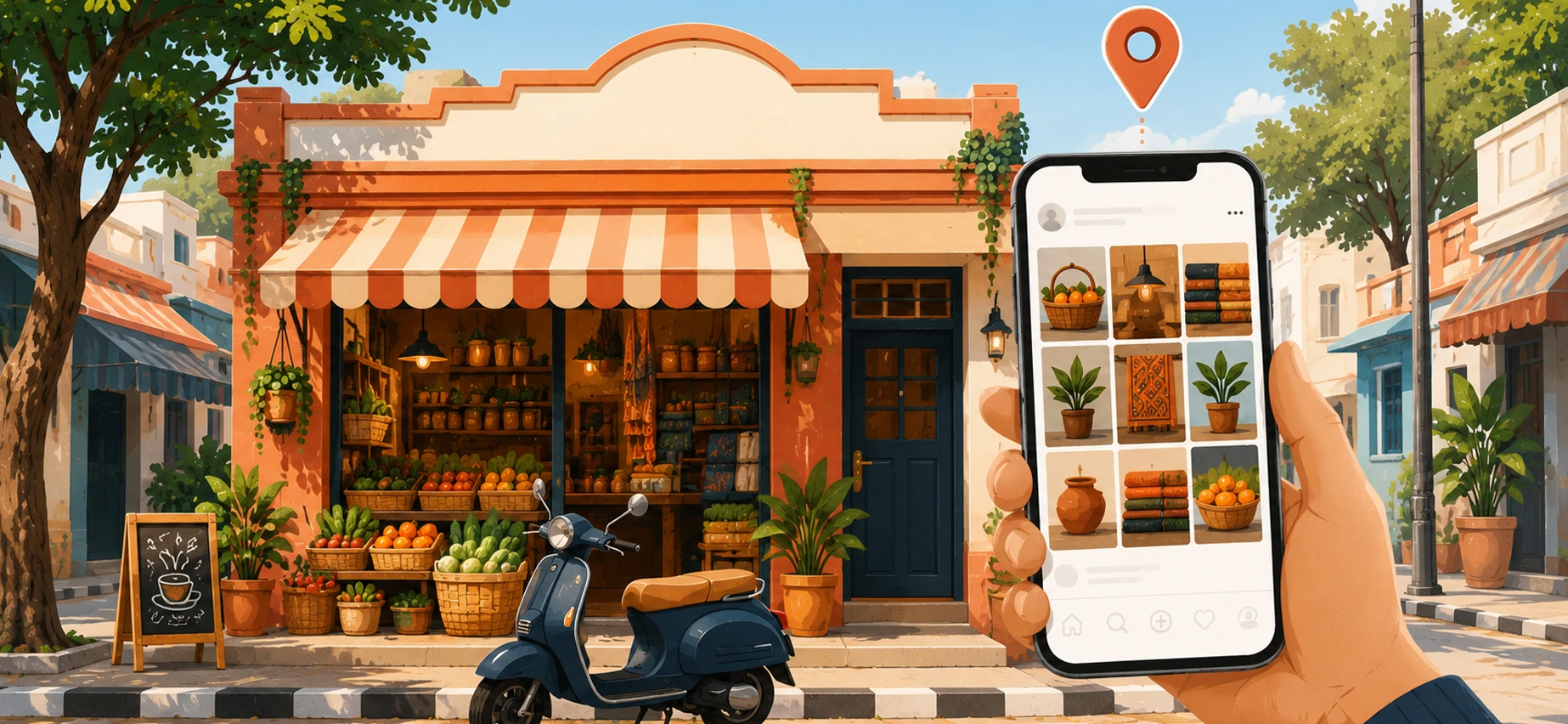
Almost every guide on growing an Instagram account organically is written for someone selling online to anyone, anywhere. Optimise the bio, post Reels, use hashtags, engage daily — reasonable advice, but it's built around one goal: more followers.
A local business has a completely different problem. If you run a boutique in Bhavnagar, a dental clinic in Rajkot, or a café in Jamnagar, a follower in Delhi is worth almost nothing to you. They will never walk through your door. Ten thousand of them still won't fill a single table.
This guide is about the other kind of growth — the kind that produces enquiries, DMs, and people physically arriving at your business, from an account that might never cross a few thousand followers. No ad spend required. It's the same principle we covered in how small brands compete with big companies: you win locally by being specific, not by outspending anyone.
Why Follower Count Is the Wrong Goal for a Local Business
The moment you start optimising for followers, you start making content designed to travel — trending audio, broad relatable humour, generic tips. That content does travel. It reaches people in cities you don't serve, inflates your follower count, and quietly makes your account worse at its actual job.
There's a second cost that isn't obvious. When a large share of your audience is outside your city, engagement from people who could actually visit becomes a smaller slice of your total. Instagram reads that engagement to decide who else to show your content to, so a geographically scattered audience makes it harder to reach the people nearby.
Here's what to track instead:
| Stop measuring | Start measuring |
|---|---|
| Total followers | Followers within your city or delivery radius |
| Likes per post | DMs and enquiries per week |
| Reach and impressions | Profile visits and link or address taps |
| Viral Reels | "I found you on Instagram" mentioned at the counter |
That last one is unglamorous and the most reliable indicator you have. Ask every new customer how they heard about you and write it down. Within two months you'll know whether Instagram is working better than any dashboard can tell you.
Set Up the Profile as a Local Business, Not a Brand
Most profile advice is about clarity of positioning. For a local business, it's about answering three practical questions within two seconds: what you sell, where you are, and how someone contacts you.
- Put your city in the name field, not just the bio — that field is searchable, so "Sharma Dental — Bhavnagar" can surface for someone searching your area, while "Sharma Dental" alone competes with every clinic of that name in the country.
- Set the account to a Business or Professional profile and add your full address, so the map and directions button appear.
- Put a WhatsApp link in the bio rather than a website homepage. For most local businesses in India, the conversation that leads to a sale happens on WhatsApp, not on a site. If you do send people to a page, make sure it earns the click — our post on 10 signs your website is costing you customers covers what usually goes wrong.
- Use Highlights the way a customer would: Menu or Price List, Location and Timings, Customer Reviews, Before and After. Not "Vibes" or "Random".
- State your timings somewhere visible. A significant share of DMs to local businesses are simply asking whether you're open.
One more that most owners skip: Instagram profiles do appear in Google results, so a profile that names your city and service is doing quiet local search work alongside everything else. Our local SEO checklist for small businesses in Gujarat covers how this fits with the rest of your local visibility, and it's the groundwork behind any search engine optimization effort for a local business.
Local Hashtags Beat Popular Hashtags — By a Wide Margin
Generic advice says use a mix of large, medium, and niche tags. For a local business, that's mostly wasted effort. Posting under a tag with twelve million entries means your post is buried within seconds by accounts far larger than yours.
City and area tags work differently. They have small enough volume that a modest post can stay visible for hours or days, and everyone browsing them is nearby by definition. A practical set:
- Your city name, and the common variations people actually type.
- Your city plus your category — the local food, shopping, or salon tags for your area.
- Your specific locality, neighbourhood, or landmark.
- Nearby towns you also serve, which are usually far less crowded than your main city tag.
- Two or three category tags for what you sell, kept relevant rather than broad.
Five to ten specific tags will consistently outperform thirty broad ones. Add the location tag to every post as well — it's separate from hashtags, and it places you in the map-based browsing that people use when looking for somewhere to go nearby.
Content That Actually Brings Local Customers
Content built to go viral and content built to bring someone to your shop are rarely the same thing. The second kind is easier to make and far less demanding to sustain, and it's the foundation of any content marketing plan that has to survive a busy trading week.
Show the place, not just the product
People need to recognise your business when they arrive. Show the storefront, the street it's on, the inside, the person behind the counter. This does something a product photo can't: it makes visiting feel familiar rather than uncertain.
Answer the questions you're asked in person
Every question a customer asks at your counter is content. Pricing, timings, what's in stock, how something works, what to choose between two options. These posts don't travel far — and they don't need to. They convert the people already considering you.
Post real customers, with permission
A photo of a local customer with your product, tagged and reposted, reaches their friends — who live in the same city. This is the single most efficient local reach mechanism on the platform, and it costs nothing. Ask, always, before posting anyone.
Tie content to local moments
Festivals, local events, weather, exam season, wedding season, market days. Content anchored to something happening in your town right now feels relevant in a way that generic seasonal content never does, and it earns saves and shares from people nearby.
Write captions the way your customers speak
A caption that opens in Gujarati and continues in English will usually outperform a purely English one in a smaller city — partly because it feels local, and partly because almost every competitor posts only in English. It's a small change with an unusually large effect on engagement.
The Collaboration Strategy Nobody Uses Properly
Most advice on collaborations means influencers. For a local business, the better move is collaborating with other local businesses that share your customers but don't compete with you.
A bridal boutique, a mehndi artist, a photographer, and a beauty salon serve the same customer at different points of the same event. A gym, a physiotherapist, and a healthy tiffin service serve the same person too. Each of you has an audience of local people the others want to reach.
What works in practice: joint Reels where each business contributes one part, a shared giveaway requiring people to follow both accounts, Story takeovers on each other's profiles, or simply tagging each other genuinely and often. Instagram's collab post feature puts a single post on both accounts and both audiences see it — the easiest available way to double local reach at no cost.
Turn DMs Into Customers, Not Conversations
Organic Instagram for a local business produces DMs. What happens next decides whether any of it was worth the effort, and this is where most accounts leak.
- Reply fast. Someone asking about price at 9pm is deciding that evening, not next week. A reply the following morning has usually arrived too late.
- Set up saved replies for your three or four most common questions so answering takes seconds rather than minutes.
- Move the conversation to WhatsApp early. It's where Indian customers are comfortable, it survives beyond the Instagram inbox, and it gives you a number you can follow up on.
- Always close with a specific next step — a time to visit, a link, a callback offer. "Let me know" ends the conversation; "Would tomorrow evening work?" continues it.
This is the same failure we see in paid campaigns, where good ads produce leads that nobody follows up quickly enough. We wrote about that pattern in why your Meta ads aren't converting — the diagnosis is identical whether the enquiry arrived free or paid.
What "Free" Actually Costs
Organic Instagram isn't free — it's paid for in time, and being honest about that is what separates a plan you'll sustain from one you'll abandon in three weeks.
A workable weekly commitment for a small business owner looks roughly like this: two to three feed posts or Reels, Stories on most days, and around fifteen minutes a day replying to comments and DMs and engaging with nearby accounts. That's about three to four hours a week, most of it in short bursts rather than long sessions.
Batch the creation. One hour on a quiet afternoon photographing and filming enough material for two weeks removes the daily pressure of thinking of something to post, which is what actually kills consistency.
And be realistic about the timeline. Organic growth typically takes around three months before reach becomes dependable and closer to six before enquiries arrive steadily. That's slower than paid advertising — but it doesn't stop the day you stop paying, which is the core of the trade-off we set out in content marketing vs paid ads. If you eventually want to combine the two, our guide to running Meta ads on a small budget covers how to add paid reach without wasting it.
Mistakes That Quietly Stall Local Accounts
- Chasing trending audio that has nothing to do with your business — it may bring views, but from everywhere except your city.
- Buying followers. Beyond being obvious, it wrecks your engagement rate and teaches Instagram to show your posts to the wrong people permanently.
- Posting only promotions. An account that is entirely offers gets muted quickly; the useful, local, human posts are what earn the right to promote occasionally.
- Leaving the address, timings, or contact method off the profile, so an interested person has to work to find you.
- Abandoning the account for a month after a slow start, right at the point where consistency was about to begin paying.
For a local business, the goal was never a bigger audience — it was a nearer one. Five hundred followers who live fifteen minutes away will outperform ten thousand who will never visit.
Want your Instagram to bring in local customers?
Buzzlane builds organic social strategies for local businesses — content that reaches people nearby, not just people scrolling.
Frequently Asked Questions
How many followers does a local business actually need on Instagram?
Far fewer than most owners assume. A shop serving one city rarely needs more than a few thousand followers, provided those followers live within travelling distance. Five hundred local followers will produce more walk-ins than ten thousand scattered across the country, so relevance matters far more than the number itself.
How often should a local business post on Instagram?
Two to three feed posts or Reels a week, plus Stories on most days, is a realistic and sustainable rhythm for a small business owner. Consistency over several months matters more than volume in any single week, and a schedule you can actually maintain beats an ambitious one you abandon after a fortnight.
Do hashtags still work for local businesses on Instagram?
Yes, but mainly the local ones. Broad tags like #food or #fashion put you in competition with millions of posts, while city and area tags such as your town name or neighbourhood put you in front of a much smaller pool of people who could realistically visit. Five to ten specific local tags generally outperform thirty broad ones.
Should a local business post in Gujarati or English on Instagram?
A mix usually works best. Captions that open in the local language and follow with English tend to feel more familiar to nearby customers while remaining readable to everyone else. Because most competitors post only in English, regional-language captions often see noticeably stronger engagement in smaller cities.
How long does it take to see results from organic Instagram marketing?
Expect roughly three months of consistent posting before organic reach becomes reliable, and around six months before it produces a steady stream of enquiries. Organic growth is slower than paid advertising but it does not stop the moment you stop spending, which is what makes it worth the wait for a local business.
Latest Posts

Satish M
With 15 years in IT and a passion for pixels, Satish is the brain behind Buzzlane. As a Web Designer and Front-End Developer turned founder, he knows what makes the web work — and more importantly, what makes it wow.