
Performance Marketing Insights & Guides
14 min read
Google Ads vs Meta Ads: Which is Better for Indian Small Businesses in 2026?

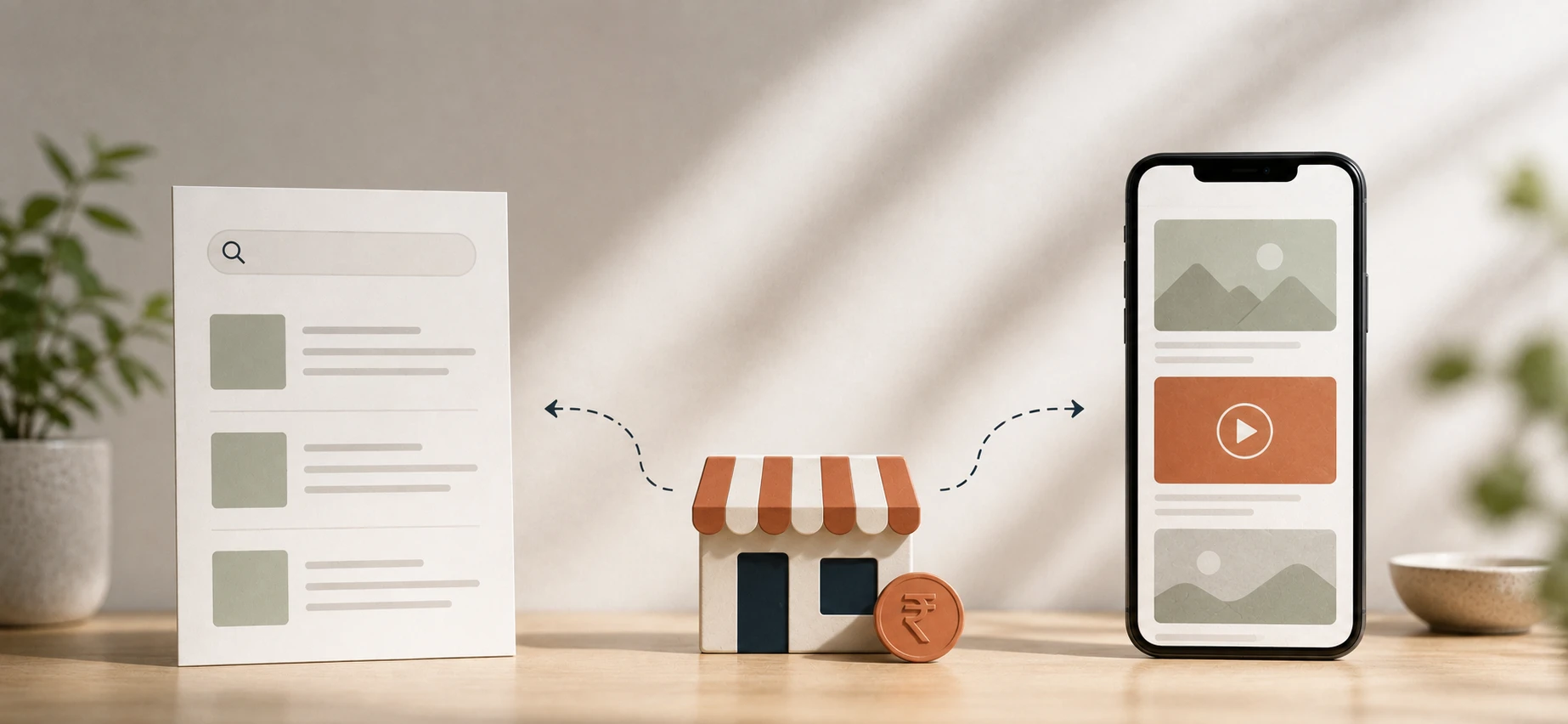
Ask this question online and you'll get the same answer everywhere: Google captures demand, Meta creates it, run both. That's true, and for a business with a few lakh rupees a month to allocate it's also useful.
It is not useful advice if you run a furniture showroom in Rajkot, a clinic in Bhavnagar, or a small D2C label shipping fifty orders a week. You don't have a budget to split. You have one budget, and putting half of it on each platform is the most reliable way to end up with two campaigns that don't work instead of one that does.
So this guide answers the narrower question that actually matters: given one modest monthly budget, which platform should you start with, and how do you know when you've got it wrong?
Start With the Difference That Decides Everything
Google shows your ad to someone who typed a request. Meta shows your ad to someone who typed nothing at all. Every other difference — cost, creative, targeting, reporting — follows from that one.
Someone searching "orthodontist near me" or "modular kitchen price Rajkot" has already decided they want the thing. Your ad's job is only to be the option they choose. Someone scrolling Instagram at 10pm has decided nothing. Your ad's job is to interrupt them convincingly enough that they want something they weren't thinking about a second ago.
That's a much harder job, and it's why the two platforms fail in different ways.
| Google Ads | Meta Ads |
|---|---|
| Captures demand that already exists | Creates demand that didn't |
| Limited by how many people search | Limited by how good your creative is |
| Higher cost per click, better lead quality | Cheaper clicks, more of them wasted |
| Works with text and a decent landing page | Needs a steady supply of photos and video |
| Fails when nobody in your city is searching | Fails when your creative goes stale |
Hold onto the two failure modes in that last row. They're the whole decision.
Do the Search Volume Check Before You Spend Anything
This is the step nearly every comparison guide skips, because most of them are written for businesses selling nationally or in cities with millions of people.
Google Ads cannot manufacture searches. If forty people a month in your district search for what you sell, then forty is your ceiling — and after excluding the ones just browsing, you might get a handful of enquiries however much budget you load. The platform will happily accept a daily budget it has no way to spend, and you'll conclude that "Google Ads didn't work" when the truth is there was nothing there to capture.
Before you commit, open Google Keyword Planner, set the location to your city rather than to India, and look at monthly volume for the five or six terms a customer would actually type. You're looking for a rough signal, not precision:
- Hundreds or thousands of local searches a month for commercial terms — Google is a serious option.
- A few dozen — Google can work as a small always-on line, but it cannot be your growth engine.
- Effectively nothing — your customers don't search for this category. Meta, or organic social, is where they are.
Categories where local search volume is usually strong: medical and dental, repairs and services, coaching and tuition, real estate, legal and financial services, travel, and anything urgent. Categories where it's usually thin: fashion and lifestyle products, home décor, handmade and gifting, food brands, and anything people didn't know existed. That second list is Meta's home ground.
What Each One Actually Costs in India in 2026
Published benchmarks vary widely because they average across wildly different industries, so treat these as planning ranges rather than quotes. Broadly, Google search clicks in India cluster in the low tens of rupees for commercial keywords, with local service categories at the cheap end and legal, insurance and finance running into hundreds or more per click. Meta clicks are far cheaper — often single digits to low tens of rupees — with cost per enquiry for well-targeted service campaigns typically landing somewhere in the low hundreds.
Three cost realities that rarely make it into the comparison posts:
- Tier-2 cities are meaningfully cheaper. The same keyword that's expensive in Mumbai or Bengaluru usually costs noticeably less in Rajkot, Surat or Indore, simply because fewer advertisers are bidding. Small-city businesses often get better economics than the benchmarks suggest.
- GST is added on top. Eighteen percent on ad spend is not a rounding error when you're working with twenty thousand rupees a month. Budget for it before you plan, not after.
- Festive season costs spike. Around Diwali and the big marketplace sale events, competition rises sharply and costs follow. If you're testing a platform for the first time, don't run your test window through the most expensive weeks of the year.
The number to compare, though, isn't cost per click. It's cost per enquiry, and then cost per customer. Cheap Meta clicks that produce nobody who buys are more expensive than costly Google clicks that produce three customers a week.
Why Splitting a Small Budget Is the Wrong Move
Both platforms optimise using conversion data. Both need a certain amount of it per week before their algorithms stop guessing — this is the learning phase, and campaigns stuck inside it deliver expensive, erratic results.
Split fifteen thousand rupees across two platforms and neither side collects enough conversions to learn. You get two campaigns permanently in beginner mode, two sets of creative to produce, two dashboards reporting numbers that contradict each other, and no way to tell which platform was actually the problem.
There's a second cost that owners underestimate: attention. Running one platform properly means checking search terms or creative performance a few times a week and acting on what you see. Running two means doing that twice, usually alongside actually operating the business. Most small campaigns die of neglect, not of bad targeting. This is the same discipline we argued for in how small brands compete with big companies — concentration beats coverage when you're the smaller player.
One platform, run properly, for ninety days. Then decide.
About Those Budget Split Percentages
Almost every comparison article ends with a table of allocations: fifty per cent Google, forty per cent Meta, the rest on retargeting, adjusted by business type. It reads like a plan. It isn't one, for you.
Those splits assume a budget large enough that each slice is still a working campaign. Take a common Indian small-business budget of fifteen or twenty thousand rupees a month, apply the same percentages, and the retargeting line becomes about two thousand rupees — an amount that will not retarget anybody. The Meta slice can't sustain creative testing and the Google slice can't gather enough conversions to optimise.
The rule of thumb worth using instead: if a slice of your budget wouldn't be a viable campaign on its own, it shouldn't be a slice. Below roughly thirty thousand rupees a month, that usually means one platform. Between thirty and sixty, one platform plus a small retargeting campaign. Above that, the split tables start to make sense.
Start With Google If This Sounds Like You
- People search for your category by name — a service, a repair, a treatment, a professional.
- The need is urgent, or has a deadline: a leaking pipe, an exam, a wedding date, a legal notice.
- Your Keyword Planner check showed real local volume.
- You have no time or ability to produce a steady stream of photos and video.
- What you sell is expensive enough that a few clicks at fifty or eighty rupees is still cheap relative to one closed sale.
Google's other advantage for a small operator is that it rewards a boring, well-organised setup: tightly themed keyword groups, ad copy that repeats the exact phrase people typed, and a landing page that matches. What it punishes is sending expensive clicks to a homepage that makes people hunt. If your site is where the money is leaking, our post on 10 signs your website is costing you customers is the more urgent read before you increase any bid.
Google spend also compounds with your organic visibility, since the searches you're paying for are ones you could eventually rank for — the groundwork in our local SEO checklist for small businesses in Gujarat, and the reason paid and organic are worth planning together.
Start With Meta If This Sounds Like You
- What you sell is visual — clothing, food, interiors, jewellery, salon or studio work, anything with a visible before and after.
- Nobody searches for your category because they don't know it exists yet.
- Your customer is defined by who they are rather than what they typed — new parents, brides, gym-goers, homeowners in a particular area.
- Your price point is low enough that an impulse decision is realistic.
- You can produce, or are willing to learn to produce, a few short videos a week.
That last point is not optional. Meta's targeting has largely automated itself; creative is now the lever you control, and stale creative gets punished with rising costs within a couple of weeks. If you can only make one video a month, Meta will feel expensive and you'll blame the platform.
Before you spend on Meta, it's worth testing your creative for free on your own account first — the approach in growing a local business on Instagram without paid ads tells you which posts people respond to, and those are the ones worth putting money behind. When you're ready to spend, running Meta ads on a small budget covers the structure that keeps a small daily spend from being wasted.
The WhatsApp Question Nobody Includes in the Comparison
International guides compare the two platforms on landing pages and form fills. In India, that misses the most important structural difference for a small business: where the conversation ends up.
Meta lets you send an ad click straight into a WhatsApp chat, skipping the website entirely. For a local service business that is often the single highest-converting setup available, because it removes every step between interest and a real conversation, and because it leaves you with a number you can follow up on next week.
Google search traffic can't do that as directly. It lands on a page, which means the page has to carry the weight — price indication, location, credibility, and a visible WhatsApp or call option near the top. Plenty of small businesses lose Google's better-quality traffic simply because the page they built was designed to look impressive rather than to answer three questions quickly.
A Realistic 90-Day Plan for One Platform
Once you've picked, the sequence matters more than the settings.
- Weeks 1–2 — build for measurement. Conversion tracking first, before a single rupee. Decide what counts as a conversion, whether that's a WhatsApp chat started, a call, or a form. If you can't measure enquiries, you're not advertising, you're donating.
- Weeks 3–6 — collect data, resist the urge to fiddle. Run a small, steady daily budget. On Google, check the search terms report weekly and add negatives. On Meta, run three or four genuinely different creative angles, not three versions of the same one. Change one thing at a time.
- Weeks 7–10 — cut and concentrate. Kill what's clearly losing and move that budget onto whatever produced enquiries. This is where most accounts finally start working, and where most owners have already given up.
- Weeks 11–13 — judge properly. Calculate cost per enquiry and, if you can, cost per customer. Compare it against what a customer is worth to you. That single ratio tells you whether to scale, fix, or stop.
Ask every enquiry where they found you and record it. Within three months that handwritten list will tell you more than either platform's dashboard, both of which will confidently claim credit for the same customer.
What's Actually Different in 2026
Two shifts matter for a small advertiser choosing today.
First, both platforms have automated most of the targeting decisions that used to separate good advertisers from bad ones. The knobs you can turn have shrunk; what you feed the system has become the lever. On Meta that means creative, and specifically how many genuinely different angles you can produce. On Google it means the quality of your keywords, your negatives and the page you send people to. Choosing a platform is now largely a question of which input you can actually supply.
Second, a growing share of buying research happens before anyone clicks an ad — in map results and in AI-generated answers where nobody is bidding. A local business that ranks in the map pack is capturing intent its competitors are paying for, which is why our guide to ranking on Google Maps in India is often the higher-return read for a local operator. The same logic applies to being named in AI answers, covered in what GEO is and how Indian businesses should prepare. Ads buy attention now; those two earn it repeatedly.
Mistakes That Waste the First ₹50,000
- Judging the first two weeks. Both platforms are at their worst while learning, and quitting in week two guarantees you paid for the education without collecting the benefit.
- Running Google search ads on broad keywords with no negative keyword list, which quietly funds clicks from people looking for jobs, free options, or a different city entirely.
- Sending every click to the homepage instead of to a page about the specific thing that was advertised.
- Boosting posts and calling it a Meta strategy. Boosted posts optimise for engagement, not enquiries — cheap, satisfying, and largely unrelated to revenue.
- Changing budgets and targeting every second day, which resets learning and ensures the campaign never stabilises.
- Skipping conversion tracking because it seemed technical, and then having no idea which half of the spend worked.
Once one platform is producing enquiries at a price you can live with, adding the second becomes straightforward — usually Meta retargeting layered under a working Google campaign, or Google search capturing the branded demand that Meta created. That combination is genuinely powerful. It's just the second move, not the first. And if you're still weighing paid spend against building organic visibility, our comparison of AI tools for small business marketing covers how to get more output from a small team while the ads do their work.
The platform question is less important than the commitment question. One platform run properly for ninety days beats two platforms run half-heartedly for a year — and it tells you something useful at the end of it.
Still deciding which platform to back first?
Paid campaigns planned and run for Indian small businesses — one platform, done properly, before a second one is added.
Frequently Asked Questions
Which is cheaper for a small business in India, Google Ads or Meta Ads?
Meta is cheaper per click and per thousand impressions, with clicks commonly in the single digits to low tens of rupees, while Google search clicks for commercial keywords usually run several times higher. But cheaper traffic is not the same as cheaper customers. Google clicks come from people already searching for what you sell, so a higher cost per click often still produces a lower cost per enquiry. Compare cost per enquiry, not cost per click.
Can I run Google Ads and Meta Ads together on a small monthly budget?
You can, but on a budget under roughly thirty thousand rupees a month it usually produces two weak campaigns instead of one working one. Each platform needs enough conversions per week to get out of its learning phase, and splitting a small budget starves both. Pick one platform, run it properly for ninety days, and add the second only once the first is producing enquiries at a cost you can live with.
How long does it take before Google or Meta ads start working?
Treat the first two to four weeks as a learning phase where results are unreliable and costs look worse than they will be. Google search campaigns often produce usable enquiries within the first month because they capture existing demand, while Meta usually needs six to eight weeks of creative testing before a winning ad emerges. Judge either platform on ninety days, not on the first fortnight.
Are Google Ads worth it for a business in a Tier-2 or Tier-3 city?
Only if people in your area actually search for what you sell in meaningful numbers. Clicks in smaller cities are typically cheaper than in the metros, which helps, but low search volume is the real limit — if your keyword gets a few dozen searches a month locally, Google simply cannot spend your budget. Check volume in Keyword Planner with your city selected before committing.
Should my ads send people to a website or straight to WhatsApp?
For most local and service businesses in India, WhatsApp converts better because it is where the buying conversation naturally happens. Click-to-WhatsApp campaigns on Meta remove the friction of a form entirely. Google search traffic still needs a landing page that answers price, location and credibility quickly, with WhatsApp available as the next step rather than a phone form nobody fills in.
Latest Posts





Relevant Post
Satish M
With 15 years in IT and a passion for pixels, Satish is the brain behind Buzzlane. As a Web Designer and Front-End Developer turned founder, he knows what makes the web work — and more importantly, what makes it wow.