
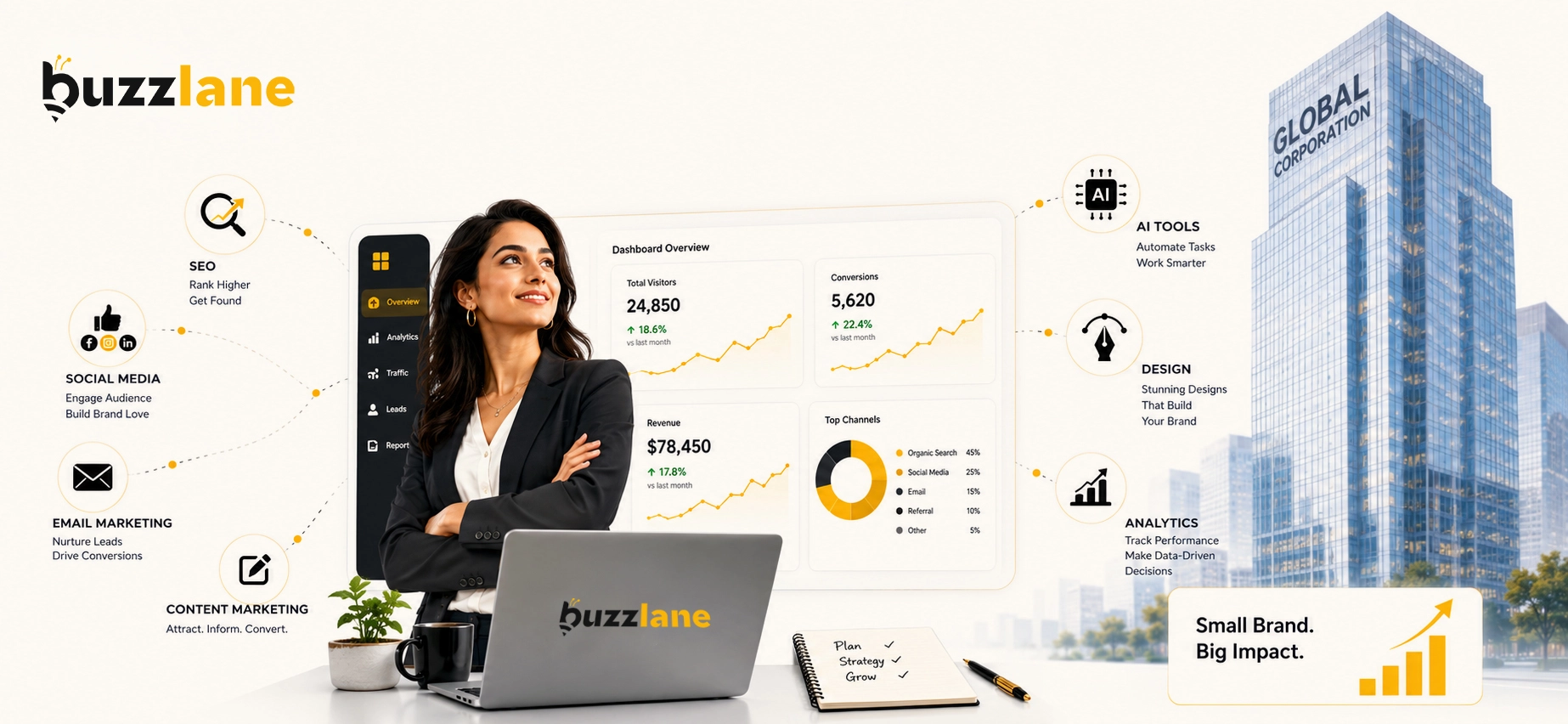
There is a widespread assumption in marketing: budget equals reach, and reach equals results. Big companies spend millions, claim the top ad slots, sponsor every event, and flood every feed. A small brand watching from the sidelines could reasonably conclude the game is already over before it begins.
That assumption is wrong — and the data is increasingly proving it. Smart digital marketing has fundamentally changed the competitive landscape, not by giving small brands an equal budget, but by making budget a much less decisive factor than it used to be. What matters now is precision, authenticity, agility, and strategic use of technology. These happen to be areas where small brands hold a structural advantage over slow-moving corporate giants.
This blog covers the specific, often overlooked tactics that small brands are using right now to pull customers away from the big players — strategies that go well beyond "just do SEO" or "be active on social media."
Large corporations run on approvals, committees, and quarterly targets. A digital trend that peaks and fades in two weeks requires a decision speed that most big brands simply cannot achieve. Their agencies write briefs, stakeholders review copy, legal clears the content — by the time a campaign launches, the moment has passed.
Small brands move differently. A founder can greenlight a campaign idea in the morning and publish it by afternoon. That is not a trivial advantage — it is a compounding one. In fast-moving digital channels, the brand that responds first to a trend, a viral conversation, or a customer concern often captures the audience that larger brands never even reach.
Additionally, large brand marketing is inherently generalised. A global company selling to millions cannot speak to any single customer with much specificity. Small brands can — and that specificity is what drives conversion in the modern attention economy.
Big brands chase celebrity endorsements and macro-influencers with millions of followers. The engagement rates on those partnerships are frequently dismal — often below 1%. Meanwhile, micro-influencers with 5,000 to 100,000 followers in a specific niche routinely deliver engagement rates of 4% to 8%, sometimes higher.
Small brands are uniquely positioned to leverage micro-influencer partnerships because their product or service often already appeals to a niche audience. A local skincare brand, a regional food business, a boutique fitness studio — these brands can partner with credible niche creators for a fraction of what a celebrity would charge, and see dramatically better results in terms of actual sales and trust-building.
User-generated content (UGC) — reviews, customer photos, unboxing videos, testimonials — consistently outperforms brand-produced content in trust and conversion metrics. According to research, consumers are 2.4 times more likely to view UGC as authentic compared to branded content. Big brands struggle to generate genuine UGC because their customers do not have a personal relationship with the brand. Small brands have the opposite problem — if they deliver an excellent product or experience, customers naturally want to share it.
The strategy is not to wait for it — it is to create conditions that encourage it. Request reviews at the right moment in the customer journey. Feature customer photos in your social feeds. Create a branded hashtag and actively promote it. Run a simple "share your experience" campaign. Each piece of UGC becomes a piece of free, credible marketing that even a ₹10 crore advertising budget cannot fully replicate.
Small brands that build a systematic UGC engine early create a compounding asset: more content, more trust, more visibility, lower customer acquisition cost.
Did You Know?
Micro-influencers generate 60% more engagement than macro-influencers — at a fraction of the cost.
National and global brands optimise for broad, high-volume keywords — and they have the domain authority to rank for them. Small brands that try to compete on the same terms will lose. The smarter play is to dominate local and hyper-specific search queries that the big players simply do not bother targeting.
Local SEO — optimising your Google Business Profile, building localised landing pages, earning reviews with location-specific keywords, and appearing in the Google Maps 3-Pack — is an area where small brands can achieve first-page visibility quickly and hold it. A user searching for "best digital marketing agency in Rajkot" or "affordable branding services near me" has strong purchase intent. Ranking for those queries delivers qualified traffic that broad keyword competition cannot match.
Email marketing consistently delivers an average return of ₹3,500 to ₹4,000 for every ₹100 spent — making it the highest-ROI digital channel available. Yet most small brands either neglect their email list entirely or send sporadic newsletters with no strategic sequencing.
Email automation changes the equation. Instead of manual sends, automated sequences nurture leads through the purchase journey without ongoing manual effort. A welcome sequence, an abandoned cart flow, a re-engagement series, a post-purchase follow-up — each of these runs automatically and turns a one-time visitor into a repeat customer.
Big brands have complex CRM systems and large email teams. Small brands using tools like Mailchimp, Klaviyo, or ConvertKit can set up powerful automation workflows in a matter of days — and the segmentation capabilities mean every subscriber receives messaging that is relevant to their specific behaviour and stage of the buying journey. That level of personalisation at scale is actually harder for large brands to achieve because of their operational complexity.
Five years ago, the technology gap between large and small brands in marketing was significant. Enterprise brands had access to sophisticated analytics platforms, AI-driven ad optimisation, and predictive audience modelling that cost hundreds of thousands of rupees annually. That gap has largely closed.
Today's AI marketing tools available at affordable monthly subscriptions give small brands capabilities that previously required entire data science teams. These tools are reshaping how small brands operate:
The brands that learn to use these tools effectively right now are building an operational advantage that will be hard to close once it is established.
Instagram Reels, YouTube Shorts, and similar short-form video formats operate on algorithm logic that is indifferent to production budgets. A video that captures genuine emotion, solves a real problem, or delivers a surprising reveal can outperform a polished ₹50-lakh brand video. The metrics that matter — watch time, shares, saves, comments — are determined by content quality and relevance, not production cost.
Small brands have a natural advantage here. Authenticity — showing the real people behind the brand, the process, the mistakes and corrections, the customer outcomes — is the highest-performing content type in short-form video. Large brands often cannot produce this content convincingly because it conflicts with their carefully managed brand image. A founder filming a 60-second video explaining how they solved a problem their customers face can generate more qualified leads than a professionally scripted brand advertisement.
Did You Know?
82% of consumers trust a brand more after reading custom content from them.
Video formats that consistently work well for small brands include: behind-the-scenes content, product demonstration with real use cases, customer transformation stories, quick educational tips in the brand's area of expertise, and transparent responses to common customer questions or objections.
Most small brands focus almost entirely on driving more traffic. Conversion rate optimisation (CRO) asks a different question: what if the traffic you already have converted better? A website converting at 1% that receives 5,000 monthly visitors generates 50 customers. Doubling conversion to 2% doubles output without spending a single additional rupee on ads or content.
CRO involves systematically identifying and removing friction from the customer's path to purchase. This includes evaluating page load speed, headline clarity, call-to-action placement and copy, mobile experience, social proof placement (testimonials, trust badges, reviews), and form length. Small brands that implement basic CRO improvements often see 20–50% increases in conversion without any increase in traffic budget.
Free and low-cost tools like Google Optimize, Hotjar, and Microsoft Clarity give small brands heatmap data, session recordings, and A/B testing capabilities that reveal exactly where visitors drop off. Big brands run CRO too — but the advantage for small brands is speed of testing. A decision that takes a large brand four weeks to implement and test can be executed in two days at a smaller company.
Paid advertising is where small brands most often feel the pressure of the budget gap. A multinational can spend ₹10 crore monthly on Meta and Google. But raw spending is not the same as effective spending. Large brands frequently suffer from audience saturation, creative fatigue, and untargeted impressions in their pursuit of scale.
Small brands that focus on high-intent targeting, retargeting warm audiences, and regular creative testing can achieve cost-per-acquisition (CPA) metrics that embarrass big-budget campaigns. The discipline of working within a tight budget forces optimisation habits that large brands, insulated by their spending power, often skip.
Most small brands chase brand awareness — the goal of being known. Big brands dominate this game through sheer spend. Small brands that chase the same goal are playing on the competitor's strongest field.
Brand positioning is a fundamentally different objective. It is not about being known to everyone — it is about being the obvious, preferred choice to a specific audience in a specific context. A small accounting firm does not need to compete with Deloitte for name recognition. It needs to position itself as the go-to accounting partner for SaaS startups in their city — a positioning that Deloitte will not bother contesting.
Clear brand positioning guides every marketing decision: which platforms to use, what content to produce, which partnerships to pursue, and how to speak to customers. Small brands with sharp positioning consistently outperform those with broad ambitions and diffuse messaging. Define the specific audience, the specific problem you solve better than anyone, and the specific reason to choose you — then build all digital marketing activity around that foundation.
Buzzlane builds smart digital strategies for growing brands.
Big brands generate extensive digital footprints — published content, ranked keywords, ad copy, social strategies — all of which can be analysed by small brands to find strategic gaps. Tools like Ahrefs, SEMrush, and SimilarWeb let you audit what keywords your competitors rank for, what content drives their traffic, which platforms they invest in, and crucially, what they are not doing.
A systematic competitor content gap analysis often reveals substantial keyword and topic clusters that competitors rank poorly for, or have not targeted at all. These gaps represent opportunities to rank with relatively lower effort while still capturing relevant search traffic. Small brands that routinely monitor competitor performance and adapt their own strategy accordingly operate with a structural intelligence advantage that pure effort cannot replicate.
A common mistake small brands make when trying to compete digitally is attempting to be present on every platform simultaneously. This dilutes effort and produces mediocre output across many channels rather than excellent output on the right ones.
The better framework is omnichannel consistency with selective presence. Choose two or three channels where your target audience is most active and your brand can show up with quality. Ensure the messaging, visual identity, and brand voice are consistent across those channels and your website. A customer who encounters your brand on Instagram, then visits your website, then receives an email should experience the same brand at each touchpoint — the same tone, the same visual standards, the same core promise.
This coherence builds the cognitive association that drives brand preference. Customers choose brands they recognise and trust — and recognition is built through repetition and consistency, not omnipresence.
The digital marketing landscape has fundamentally restructured competitive dynamics. Budget still matters — but it is no longer the primary determinant of marketing effectiveness. Precision targeting, authentic content, smart automation, and data-driven decision-making now deliver returns that mass spending cannot guarantee.
Small brands that understand and execute on this reality — building micro-influencer networks, systematically generating UGC, automating email journeys, deploying AI tools, creating authentic short-form video, and continuously optimising conversion — are not just surviving against big competitors. They are regularly winning.
At Buzzlane Agency, we work with small and growing brands to build precisely this kind of intelligent digital presence — strategies designed not to imitate what big brands do, but to win in the spaces where small brands hold the structural advantage.
The question is not whether small brands can compete with big companies using smart digital marketing. The question is: how long can big companies keep up with small brands that are doing it well?
Yes. Smart digital marketing reduces the importance of raw budget by rewarding precision targeting, authenticity, and speed — areas where small brands have a structural advantage over larger, slower-moving competitors.
Start with short-form video content and basic conversion rate optimisation. Both require minimal budget, can be implemented quickly, and directly improve results from existing traffic and audience.
No. Choosing two or three platforms where your audience is most active and maintaining consistent branding across them performs better than a thin presence spread across many channels.
AI tools can assist with content creation, email automation, customer segmentation, and competitor analysis — helping small teams operate with the efficiency of a much larger marketing department.
With 15 years in IT and a passion for pixels, Satish is the brain behind Buzzlane. As a Web Designer and Front-End Developer turned founder, he knows what makes the web work — and more importantly, what makes it wow.